English

Views: 0 Author: Site Editor Publish Time: 2026-10-21 Origin: Site


Selecting the wrong core material for a building envelope causes serious issues. It often leads to strict compliance failures or severely compromised thermal efficiency. Architects and facility managers face a complex choice today. You must move past basic product definitions to make informed decisions. Balancing upfront budget constraints against strict local fire codes requires deep technical knowledge. Long-term energy performance demands also complicate this selection process.
This guide provides a transparent, data-driven framework. We will help you finalize the core material specification for commercial, industrial, and cold-storage projects. You will learn the exact constraints of EPS, PU, PIR, and Rock Wool cores. We explore real-world fire ratings, thermal drift, and structural limits. By the end, you can confidently match the right panel to your specific project needs.
EPS: Lowest initial cost; best for temporary or non-critical structures; lowest fire resistance.
PU (PUR): Excellent thermal insulation (U-value); susceptible to stricter fire regulations; standard for general cold storage.
PIR: Upgraded thermal and fire performance over PU; the modern standard for energy-efficient commercial builds requiring FM approvals.
Rock Wool: Unmatched fire resistance and acoustic performance; heavier panel weight requires structural considerations; best for high-risk industrial facilities.
Understanding the chemical and structural reality of each core is essential. We strip away marketing fluff to reveal actual constraints. Every material presents unique benefits alongside specific operational risks.
Expanded Polystyrene consists of 98 percent air. Manufacturers value its lightweight nature. Buyers appreciate the highly cost-effective profile. However, it remains structurally less rigid compared to denser alternatives. Under high heat, EPS melts quickly. It offers almost no resistance to open flames. Modern building codes often restrict its use entirely. High-occupancy commercial projects usually require safer, more robust options. Specifying an EPS Sandwich Panel makes sense only in strictly controlled, low-risk environments.
Polyurethane forms a dense, closed-cell foam. This internal structure delivers exceptional thermal insulation. Engineers measure this as a very low thermal conductivity or lambda value. Despite excellent insulation, older PU formulations pose significant risks. They remain combustible if left untreated. Fire safety inspectors scrutinize these materials closely. Newer formulations exist, but baseline PU still struggles against strict fire codes. A PU Sandwich Panel performs exceptionally well in general cold storage. Facility managers must simply verify local code acceptance before installation.
Polyisocyanurate shares basic chemical similarities to PU. However, chemists alter the formula to create a highly cross-linked structure. This crucial change dramatically improves fire behavior. PIR chars during a fire rather than melting. This protective char layer insulates the inner core from further damage. You pay a slightly higher upfront price for this upgrade. Precise manufacturing processes prevent layer delamination over time. Specifying a PIR Sandwich Panel ensures optimal compliance in strict regulatory zones.
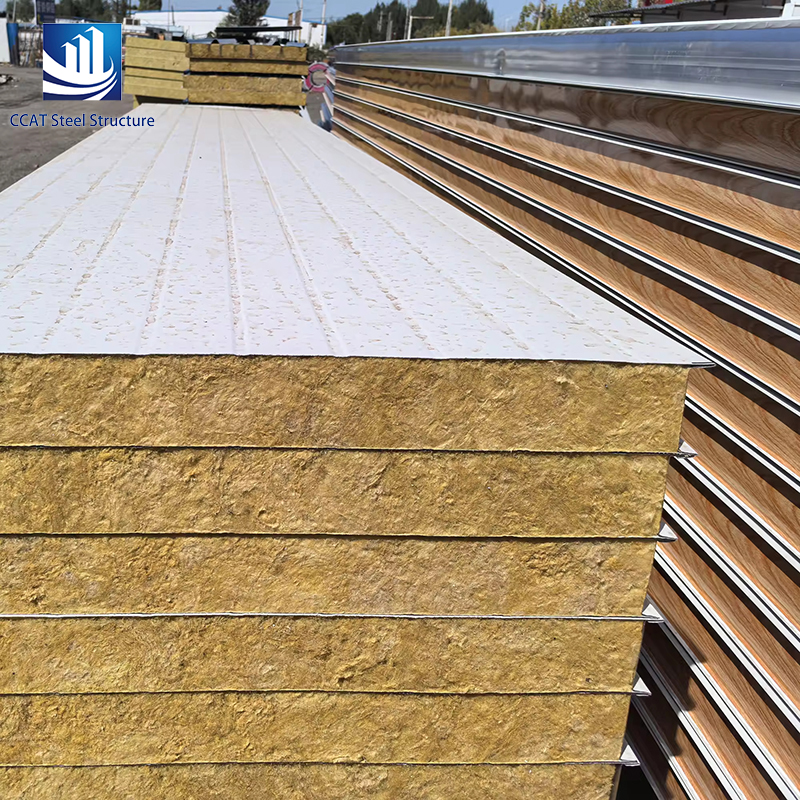
Mineral wool consists of spun volcanic rock and recycled slag. It is entirely non-combustible. Testing laboratories routinely award it the top A1 fire rating. However, extreme density increases panel weight significantly. Structural engineers must often reinforce secondary steelwork to support the extra load. Moisture poses another severe threat here. If the outer steel facing fails, the core absorbs water rapidly. A saturated Rock Wool Sandwich Panel loses its insulating capability and structural integrity entirely.
Objective metrics must drive your final decision. We utilize a comparative approach to evaluate these four materials. The matrix below contrasts their performance across critical engineering requirements.
Table 1: Core Material Evaluation Summary
Core Material | Fire Rating (EN 13501-1) | Thermal Conductivity (W/m·K) | Acoustic Performance | Structural Weight |
|---|---|---|---|---|
EPS | E - F (Combustible) | 0.035 - 0.040 | Poor | Very Light |
PU | B - C (Combustible/Treated) | 0.020 - 0.024 | Moderate | Light |
PIR | B-s1, d0 (Self-extinguishing) | 0.020 - 0.022 | Moderate | Light |
Rock Wool | A1 (Non-combustible) | 0.038 - 0.045 | Excellent | Heavy |
Navigating fire standards requires careful attention to detail. European standard EN 13501-1 categorizes materials based on combustibility, smoke emission, and flaming droplets. FM Approvals, specifically FM 4880, test large-scale fire behavior in real-world scenarios. You must contrast the complete non-combustibility of Rock Wool against the self-extinguishing properties of PIR. Rock Wool achieves an A1 rating, offering ultimate peace of mind. PIR achieves a B-s1, d0 rating, which satisfies most modern commercial codes. We strongly warn against relying on EPS in any fire-prone zones. Its tendency to melt and spread flames makes it a significant liability in high-density areas.
Best Practice: Always request specific certification documents from the manufacturer. Do not accept generic claims of "fire resistance" without corresponding FM or EN test data.
Thermal efficiency dictates the ongoing climate control demands of your facility. PU and PIR cores achieve identical insulation values at roughly half the thickness of Rock Wool or EPS. This efficiency stems from their dense, closed-cell gas structures. However, engineers must account for "thermal drift." Thermal drift describes the gradual loss of insulation value as blowing agents escape the foam over years. High-quality steel facings mitigate this issue effectively. Impermeable metal skins trap the insulating gases inside PU and PIR panels. Rock Wool does not suffer from thermal drift, but requires significantly thicker panels to match the baseline U-value of modern foams.
Common Mistake: Specifying panel thickness based solely on initial R-values. Always calculate the long-term aged thermal resistance to ensure accurate HVAC sizing.
Acoustic control often takes a back seat during initial planning. Yet, it remains crucial for industrial environments. Rock Wool demonstrates absolute superiority in sound deadening. Its dense, fibrous structure traps sound waves efficiently. We highly recommend it for factory noise isolation or heavy manufacturing zones. When comparing span capabilities, PIR and PU panels offer superior stiffness-to-weight ratios compared to EPS. This inherent stiffness allows builders to use fewer secondary supports. EPS lacks this rigidity, requiring closer purlin spacing to prevent sagging under wind or snow loads.
Mapping materials directly to specific project types facilitates a clearer shortlisting logic. Different environments demand vastly different performance characteristics from their building envelopes. Use this framework to align your project type with the optimal core.
Cold Storage and Food Processing
Winner: PIR or PU.
Why: These environments demand aggressive temperature control. The closed-cell structure prevents moisture ingress entirely. It also maximizes usable interior space. Thinner insulated walls mean more pallet space for inventory. Food processing facilities also benefit from the hygienic, easy-to-clean steel facings typically paired with foam cores.
High-Risk Industrial and Warehousing (Chemicals, Data Centers)
Winner: Rock Wool.
Why: These facilities house volatile materials or critical infrastructure. Ultimate compartmentalization for fire safety becomes the primary design driver. An A1 non-combustible core contains fires to specific zones. This containment prevents catastrophic facility-wide losses and protects human life during evacuations.
General Commercial and Logistics Hubs
Winner: PIR.
Why: Warehouses and retail centers require a balanced approach. PIR represents the optimal middle ground. It delivers high thermal efficiency, acceptable fire ratings, and moderate structural weight. Builders can erect large distribution centers quickly using standard lifting equipment. The material meets strict municipal building codes without over-engineering the structural frame.
Agricultural and Temporary Facilities
Winner: EPS.
Why: Equipment sheds, temporary site offices, and livestock housing operate under different constraints. These are strictly budget-driven environments. Stringent fire codes rarely apply to unoccupied or temporary structures. EPS provides basic weather protection and moderate insulation at the lowest possible price point.
Moving beyond the per-square-meter price tag requires analyzing rollout realities. Hidden complexities during construction can derail project timelines. Facility managers must proactively address installation hurdles and long-term physical maintenance requirements.
Panel weight drastically alters your construction schedule. Rock wool panels are exceptionally heavy. Construction crews cannot maneuver them by hand. You must address the need for specialized vacuum lifting equipment. Cranes and heavy machinery increase site congestion. Consequently, installing high-density panels results in potentially slower installation times compared to lightweight EPS or PU. Builders can position rigid foam panels rapidly. You must align your labor budget and equipment rental contracts to match the physical realities of your chosen core material.
Best Practice: Conduct a site access audit before ordering heavy mineral wool panels. Ensure your site can accommodate the swing radius of large cranes required for installation.
Environmental exposure threatens the integrity of any sandwich panel if installed incorrectly. We strongly advise emphasizing proper joint sealing protocols. Mineral wool loses its insulating efficacy entirely if it gets wet. Water trapped inside the core also accelerates internal steel corrosion. EPS faces different environmental threats. It can delaminate under severe temperature fluctuations. Expanding and contracting trapped air stresses the adhesive bond between the steel facing and the core. Installers must apply high-grade butyl tapes and specialized sealants at every joint. Proper flashing details around windows, doors, and parapets prevent water ingress, ensuring the envelope performs as engineered.
Common Mistake: Relying solely on the factory-cut interlocking joints to stop water. Always use continuous secondary sealants in high-humidity or high-rainfall climates.
There is no universal "best" panel for every building. You will only find the right panel for your specific compliance, thermal, and structural constraints. EPS serves budget-conscious, temporary needs. PU offers reliable cold storage insulation. PIR dominates modern commercial logistics through balanced performance. Rock Wool provides unmatched fire containment for heavy industry.
Take proactive steps before finalizing your procurement order. Consult structural engineers to review span tables and wind load requirements. Speak directly with local fire marshals to confirm exact code requirements for your specific zone. Do not assume older codes still apply to new builds.
We prompt you to request detailed technical data sheets (TDS) from your chosen manufacturer. Ask an application engineer to model the expected thermal performance for your specific regional climate. Precise data ensures your final specification guarantees safety, compliance, and long-term performance.

A: The primary difference lies in their chemical structure. PIR features a highly cross-linked polymer matrix. This chemical alteration gives PIR significantly better fire resistance. While PU can ignite and burn, PIR chars upon exposure to flames. This charring creates a protective barrier, preventing the core from melting or contributing to fire spread.
A: They are not universally banned everywhere. However, authorities strictly regulate or penalize their use in high-occupancy or high-risk zones. Many modern municipal building codes prohibit EPS due to its rapid melting and flame-spreading characteristics. Always verify local fire regulations before specifying EPS for any permanent commercial structure.
A: Rock Wool represents the best choice for acoustic insulation. Its dense, fibrous mineral structure excels at absorbing and deadening sound waves. Unlike rigid closed-cell foams, the fibrous matrix traps airborne noise effectively. Engineers specify it heavily in noisy manufacturing plants or facilities requiring strict internal acoustic isolation.
A: Yes, the exposed mineral wool core is highly moisture-sensitive. It will absorb water rapidly if exposed. However, standard panels feature impermeable steel facings. Proper joint detailing, continuous sealants, and intact metal skins successfully prevent water ingress. Maintenance teams must repair any punctures to the steel facing immediately to protect the core.


